Showing posts with label Symmetry. Show all posts

Sunday, March 23, 2025

Alternative computations at once

DIY experiment: Relativity of information

Whatever meaning we see in a computer or in the information it stores and the computation it does, this meaning is due to our own conventions. If we change the convention, we change the meaning. Without us to make the convention there is no meaning in a computer.

This is a JavaScript program that demonstrates that when a computer does a computation, it also does the computations for the other possible inputs, simultaneously. The alternative computations are "encrypted" in that computation, and they can be "decrypted" by changing the convention.

For this demonstration, the program verifies if a partition of a list of numbers into two sublists is fair, that is, if the sums of the two sublists of numbers are equal (the partition problem). The program does the verification only once, for a default partition which is maximally unfair, and it can decrypt the results for any other partition, finding even the possible fair partitions.


You can verify the source code by yourself (right-click and select from the menu to view the code or run it line-by-line). To put this in context, see my paper "Does a computer think if no one is around to see it?" and my YouTube videos "Are you a robot?" totalizing 46' minutes.

Input data

Monday, September 23, 2024

Is consciousness grounded in matter or the other way around?

 Is consciousness grounded in matter or the other way around?


We will ask physics about physicalism, zombies, and consciousness.
This video is an as-simple-as-I-could explanation of this article https://philsci-archive.pitt.edu/23108/.
We will use a bit of physics and math, but I'll introduce these smoothly, to make the trip easy and interesting. You can verify each step of the proof, and if you can find an error, please let me know. Many of the implications of this result remain open to be discussed later. 


Abstract of the article

If the mind of a sentient being would be reducible to its structure, any system with identical structure should be equally sentient. Based on the structural symmetries of Physics, I prove that this thesis has two unexpected consequences:

1) There would be an inflation of minds, living in apparently different worlds.
2) The content of these minds would be independent of the properties of the external world. That is, these minds would be unable to know anything about the world.

Since this contradicts empirical observations, structure alone is insufficient for sentient experience.

This excludes the purely physicalistic approaches to physics and consciousness. For physics to be as we know it, all physical properties have to be grounded in something sentiential.


Saturday, April 16, 2022

An underrated gem: WAY beyond conservation laws


I think the article Wigner-Araki-Yanase theorem beyond conservation laws by Mikko Tukiainen is an underrated gem (if we compare its content to the number of citations).


Here's why I think so.

First, I think the Wigner-Araki-Yanase theorem is underrated. It started with a paper by Wigner (here is an English translation.), who showed that you can't have an accurate ideal spin measurement which is also repeatable. By "repeatable" it's understood that, whatever result you get, by repeating the measurement you'll get the same result. In other words, accuracy requires that the measurement disturbs the system, so the spin is no longer what you measured it to be. You can avoid this by being satisfied with a less accurate result. Wigner also showed that repeatability can be obtained and the error can be made as small as wanted, if the measuring device is large enough so that the apparatus has large uncertainty for the conserved quantities.

Araki and Yanase generalized his result, and added some interesting observations, in particular that this limitation applies to the measurement device as well.

Wigner was brilliant enough to know how to give a more general proof, but he wanted the idea to be understood easily. He used the conservation of angular momentum along an axis to deduce the limitation of accuracy of spin measurement along an orthogonal axis. He only uses a conservation law, but all conservation laws contribute. He had to give a simple proof, without making too many assumptions about the evolution equation. So he probably thought, spin measurement is a simple example, and also entails the existence of other spin operators that are conserved by unitary evolution and don't commute with it.

While all conservation laws contribute limitations, on the one hand this is an expression of the symmetries, and on the other hand, in fact, they don't do anything. The limitation is in the transformation of the total state from the state before measurement into the state after the pre-measurement, that is, just before we invoke the collapse postulate (the collapse itself breaks the conservation laws). During pre-measurement the evolution is unitary, because collapse is invoked at the end. The evolution itself constraints the possible results of the measurement. Conservation laws were originally used as indications that we can use to find such limitations. A general proof in terms of general unitary transformations is very difficult, but you can look at a conserved quantity and deduce enough to know that the accuracy is limited if we want repeatability. So the conservation law was used to give a simple, although less general, proof. And to make it simpler, the conserved quantity had to be additive.
 
But these are just assumptions Wigner made to prove the result, and this made me initially think that there is nothing special or metaphysical about conservation laws in this context, despite Wigner's other very important realizations about the role of symmetry. But there is a very important lesson about symmetries (which, as we know from Emmy Noether, are the reason behind the conservation laws), as elucidated by the works of Ozawa, Loveridge, Busch, Miyadera and others.

Conservation laws are often used to deduce things without solving equations. But they don't constrain, they express the constraints of the system, since these constraints restrict the symmetries, and therefore the conservation laws. On the other hand, the symmetries of the system really capture an important aspect of the constraints, as explained in this wonderful article by Loveridge, Busch, and Miyadera.

The reason why I consider Mikko Tukiainen's paper important is that it seems to indicate another deeper aspect, that seems to go beyond that. He not only it gave a more general proof, but in that proof, conservation laws play no role (you can read it for free here). He used instead the idea of quantum incompatibility, which is a way to understand the major features of quantum mechanics that distinguish it from classical mechanics (although the most useful examples are still given by conservation laws). This is neat, complements the idea based on symmetry, and it's in some sense more general.

Both the symmetries and quantum incompatibility go deep, but maybe there is a deeper reason than both of these - the full range of such limitations of measurements is still unknown. And maybe there is no general characterization of this. But anyway, I think there's more to be learned about this.

Since both the WAY papers together have together a relatively small number of citations (hundreds), I consider them underrated too. This is another mystery to me.

Wednesday, February 15, 2017

The Standard Model Algebra

arXiv link: https://arxiv.org/abs/1702.04336
A simple geometric algebra is shown to contain automatically the leptons and quarks of a generation of the Standard Model, and the electroweak and color gauge symmetries. The algebra is just the Clifford algebra of a complex six-dimensional vector space endowed with a preferred Witt decomposition, and it is already implicitly present in the mathematical structure of the Standard Model. The minimal left ideals determined by the Witt decomposition correspond naturally pairs of leptons or quarks whose left chiral components interact weakly. The Dirac algebra is a distinguished subalgebra acting on the ideals representing leptons and quarks. The resulting representations on the ideals are invariant to the electromagnetic and color symmetries, which are generated by the bivectors of the algebra. The electroweak symmetry is also present, and it is already broken by the geometry of the algebra. The model predicts a bare Weinberg angle θW given by sin2(θW)=0.25.


Saturday, March 14, 2015

Round squares exist

Bertrand Russell said that there are no round squares. But there are. Here are two solutions.

A circle-square

This is a square that is circle:

To make it, first make a paper circle and  a paper square, with equal perimeters:


Fold them a bit:


Then glue their edges together:


The common boundary forms a square that is circle. It is a square, because in the blue surface it has right angles and equal straight edges. It is a circle, because in the red surface its points are at equal distance from a point. In fact, its points are at equal distance from the center even in space, because the red surface is ruled, and all the lines pass through the same point. So the common boundary is also a line on the surface of a sphere.

Round squares in non-Euclidean geometry

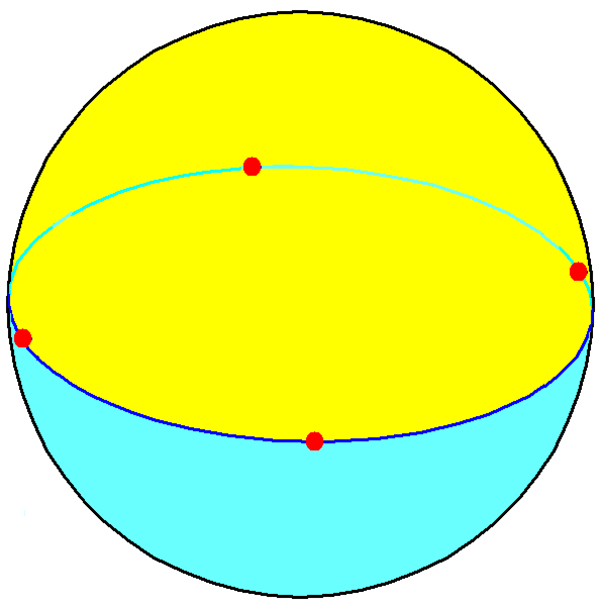
Consider for example the geometry on a sphere. On a sphere, polygons are made of the straightest lines on the sphere, which are arcs of the big circles. So, there are squares on a sphere

Image from Wikipedia
This is a square, since its edges are the shortest and straightest lines on the sphere, they have equal lengths, and its angles are all equal. If one gradually increases the size of the square, the angles increase too. At some point, the angles become $180^\circ$, and the edges become aligned, forming one single big circle:

Image from Wikipedia

So, is it a circle? Is it a square? It's a circle and a a square!